



Blocked teeth that can't erupt — and almost always need to come out
An impacted tooth is one that lacks space to fully break through the gum. Wisdom teeth — the last molars to erupt, typically between ages 17 and 25 — are most commonly affected. Because the modern jaw rarely has room for them, they stay trapped, and the longer they remain, the greater the risk of complications.
- Impaction caused by crowding, rotation, or an obstruction from an adjacent tooth
- Partially erupted teeth create pockets where bacteria collect and infection develops
- About 85% of wisdom teeth will eventually require extraction
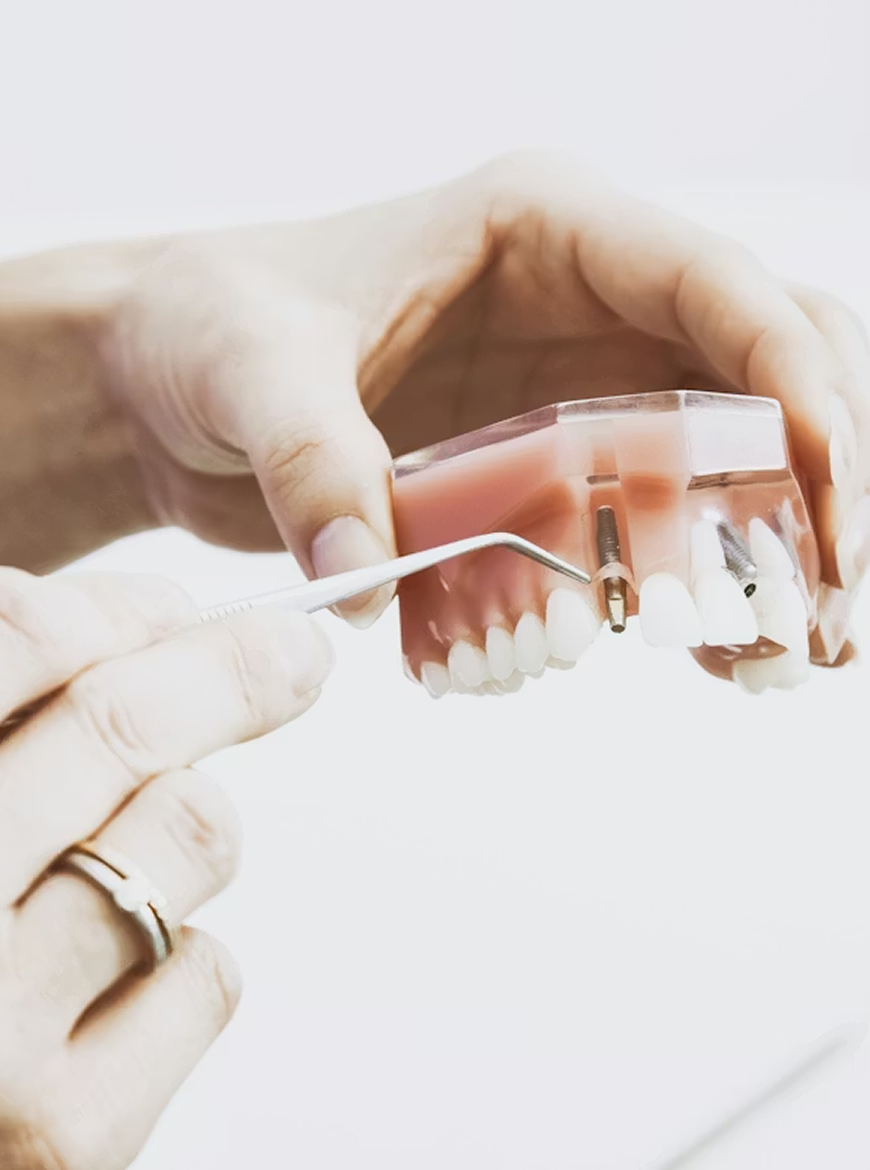

The longer you wait, the more complicated the extraction becomes
As wisdom teeth remain in the jaw, their roots continue to grow — sometimes curving around nearby nerves. The longer removal is postponed, the more likely those roots are to wrap around sensitive facial nerves, making extraction more involved and recovery longer. Younger patients heal significantly faster and experience fewer complications.
Beyond the impacted tooth itself, the pressure it exerts on neighboring teeth can cause crowding, shifting, and malocclusion. A partially erupted tooth above the gumline creates a hard-to-clean trap where decay and gum disease take hold. In rare cases, fluid-filled cysts form around the impacted tooth and can hollow out the surrounding jawbone if left untreated.
Impacted teeth — your questions answered
From what causes impaction to what recovery looks like — covered clearly.
A tooth becomes impacted when it cannot fully erupt through the gumline. Common causes include insufficient space in the arch, a neighboring tooth blocking the path, or a tooth that has grown at the wrong angle. In advanced cases — called ankylosis — the impacted tooth’s roots fuse to the surrounding bone, locking the tooth in place entirely.
Wisdom teeth are the last to arrive — typically between 17 and 25 — and by that point the dental arch is already fully established. Modern diets are softer than those of our ancestors, so teeth don’t wear down and drift to create space. Orthodontic treatment further fills the arch. With nowhere to go, wisdom teeth are trapped behind the second molars and become impacted far more often than any other tooth.
An untreated impacted tooth exerts pressure on the arch, pushing neighboring teeth out of alignment. It can erode the roots of the teeth next to it and create pockets below the gumline where decay and infection take hold. In more serious cases, a fluid-filled cyst develops around the impacted tooth — and if that cyst enlarges, it can permanently damage surrounding bone, teeth, and nerves. Waiting until pain appears does not mean waiting safely.
Before the procedure, Dr. Patel reviews your X-rays and discusses anesthesia options — local anesthesia, IV sedation, or general anesthesia depending on the complexity and your preference. Partially impacted teeth may require a minor incision in the gum and the removal of a small amount of surrounding bone. Fully impacted teeth may be sectioned into smaller pieces for easier removal. The procedure is completed in the office, and most patients go home the same day.
Some swelling and mild discomfort in the days following surgery are normal. Cold compresses help reduce swelling, and prescribed medication manages pain. A soft diet is recommended initially, progressing to normal foods as healing allows. Younger patients — treated before their roots fully develop — typically recover faster with fewer complications. Dr. Patel provides post-operative instructions and a follow-up to confirm the site is healing properly.
Ready to address your impacted teeth?
Book an evaluation with Dr. Bhargav Patel today.